Santos Dumont: 120 years since the flight all of Paris saw
On November 12, 1906, a 33-year-old Brazilian flew 220 meters in front of a crowd. The dispute over who flew first started there and is still going.
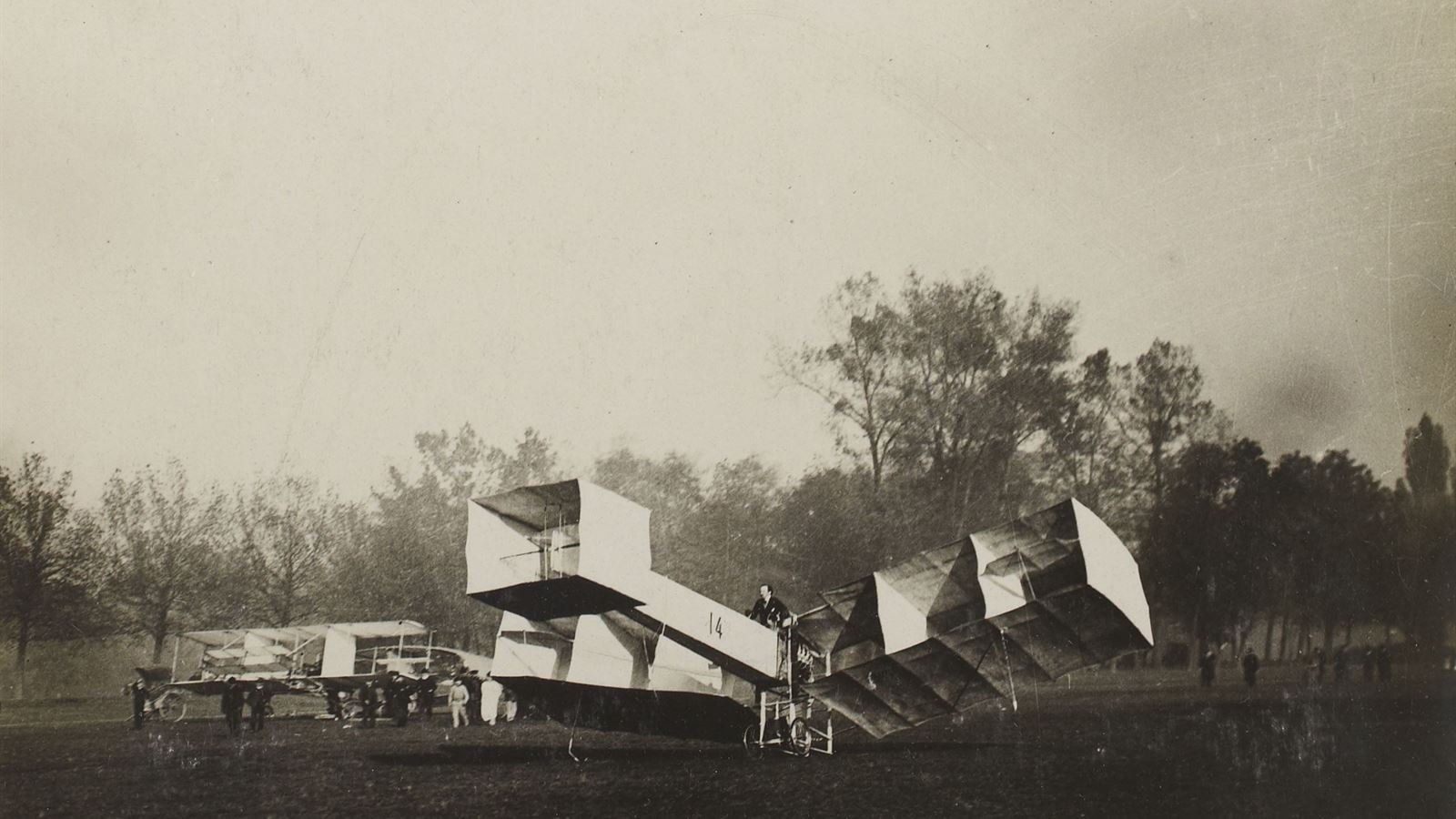

At 4:45 p.m. on November 12, 1906, as the day was ending, Alberto Santos Dumont took the 14-bis into the wind at the Bagatelle field in Paris. The plane covered 220 meters in the air in 21 seconds.
There were judges from the Aéro-Club de France, journalists and a crowd. A film company, Pathé, recorded the flights that day. Exactly 120 years ago, the world saw for the first time an airplane take off on its own, without a ramp or catapult, and set an official record.
The son of a coffee king
Santos Dumont was born on July 20, 1873, in Palmira, a town in the Brazilian state of Minas Gerais that now bears his name. He was the sixth of eight children of Henrique Dumont, a Paris-trained engineer who made a fortune growing coffee in the state of São Paulo.
On the farm, the boy was fascinated by the machines that processed the beans and read Jules Verne's books. He built kites and small rubber-band-powered planes.
In 1891, his father had an accident that left his health weakened. In February 1892, he granted his 18-year-old son legal emancipation, gave him part of his inheritance and advised him to study mechanics, chemistry and electricity. Alberto went to live in Paris, then the world center of science and aeronautics.
Around the Eiffel Tower
Before the airplane came balloons. Santos Dumont wanted aircraft that went where the pilot wanted, not where the wind blew. So he fitted gasoline engines to elongated balloons, the airships.
In 1900, millionaire Henri Deutsch de la Meurthe offered 100,000 francs to anyone who could leave Saint-Cloud, circle the Eiffel Tower and return within 30 minutes. The course was about 11 kilometers.
On October 19, 1901, in his airship Number 6, Santos Dumont completed the course in 29 minutes and 30 seconds. There was a dispute over the landing time, but the prize was eventually awarded. He split the money between his mechanics and the poor of Paris.
The Brazilian became a celebrity. He flew his airship to cafés in the city, and jeweler Louis Cartier made him a wristwatch so he could check the time without taking his hands off the controls. Pocket watches were still the norm.
The 14-bis
In 1906, Santos Dumont moved on to heavier-than-air machines. The 14-bis had box-shaped wings, inspired by kites, and its rudder at the front. That is why it seemed to fly backwards.
On October 23, 1906, at Bagatelle, he flew about 60 meters at a height of two to three meters and won the Archdeacon Prize, which required at least 25 meters. The crowd carried him on their shoulders. The judges, carried away, forgot to time the flight, and the record was not certified.
So he came back on November 12. He made five flights that day, up to the 220-meter one, which won him the Aéro-Club de France prize for anyone flying more than 100 meters. It was the first officially recognized aviation record.
Who flew first?
In the United States, Orville and Wilbur Wright had flown on December 17, 1903, at Kitty Hawk, North Carolina. The Fédération Aéronautique Internationale recognizes that as the first controlled, powered airplane flight.
Santos Dumont's supporters point to two differences. The Wrights' flights had few witnesses and were only demonstrated publicly in 1908. And from 1904 on, they used a catapult to take off, while the 14-bis left the ground on its own wheels.
The Wrights' supporters note that the 1903 Flyer took off without a catapult, from a rail, and that by 1905 they were making flights of more than half an hour, with turns. The 14-bis flew in a straight line for a few seconds.
The answer depends on the criterion. If the question is who flew first, most historians outside Brazil point to the Wrights. If it is who made the first public, certified flight with its own takeoff, the answer is Santos Dumont.
The Demoiselle and the free plans
The 14-bis crashed and was abandoned in 1907. Santos Dumont then turned to a small, light plane, the Demoiselle, considered the forerunner of ultralight aircraft.
He did not patent the design. In 1910, the Demoiselle plans were published in the American magazine Popular Mechanics, and hundreds of copies were built in Europe and the United States.
Soon afterwards, with health problems, he stopped flying. His last accident, in a Demoiselle, was in January 1910.
The last years
During the First World War, Santos Dumont saw airplanes used to bomb cities. The following years brought depression and hospital stays. The traditional diagnosis of multiple sclerosis is now questioned by researchers, who see signs of psychiatric illness.
In 1932, he was in Guarujá, on the São Paulo coast, when the Constitutionalist Revolution broke out. On July 23, government planes attacked the Campo de Marte airfield in São Paulo. That day, at age 59, Santos Dumont took his own life.
In 1936, a Brazilian law made October 23, the date of the 14-bis's first flight, Aviator's Day in Brazil.
If you are going through a difficult time, please reach out to a local crisis line. In Brazil, CVV answers for free at any hour on 188 or at cvv.org.br.
Quick questions
Did Santos Dumont invent the airplane?
He made the first public, certified airplane flights, in 1906 in Paris. The Wright brothers flew earlier, in 1903, but without an audience, which is why the dispute continues.
How far did the 14-bis fly?
About 60 meters on October 23, 1906, and 220 meters on November 12, 1906, in 21 seconds.
Where was Santos Dumont born?
In Palmira, Minas Gerais, a town now called Santos Dumont, on July 20, 1873.
Why is Santos Dumont linked to the wristwatch?
Jeweler Louis Cartier made him a wristwatch so he could check the time while flying.
Sources
- Wikipedia: Alberto Santos-Dumont
- Wikipedia: Santos-Dumont 14-bis
- Wikipedia in Portuguese: Santos Dumont
- Wikipedia: Wright brothers
- Brazilian Law 218/1936, Aviator's Day (in Portuguese)
Found an error? See how we fact-check and correct.