Mikhail Gorbachev: the reformer who did not want to end the Soviet Union
In December, the end of the Soviet Union turns 35. The last Soviet leader tried to save the country with reforms and ended up watching it fall apart. Russia and Ukraine still live with the consequences.

On the evening of December 25, 1991, Mikhail Gorbachev appeared on television to announce that he was stepping down as president of the Soviet Union. Shortly afterwards, the red flag with the hammer and sickle was lowered over the Kremlin and replaced with the Russian flag. The world's largest country had ceased to exist.
Thirty-five years later, Russia and Ukraine, once the two largest Soviet republics, have been at war since 2022 and are negotiating prisoner swaps and ceasefires. Much of that story begins with the man who tried to reform the Soviet system and ended up presiding over its end.
The son of peasants
Gorbachev was born on March 2, 1931, in Privolnoye, in southern Russia, to a peasant family of Russian and Ukrainian heritage. Both of his grandfathers were arrested during Joseph Stalin's purges.
He studied law at Moscow University, where he met his wife, Raisa, and built a career in the Communist Party in the Stavropol region. In 1978, he was brought to Moscow to oversee agriculture. He was the youngest member of a party leadership dominated by men twice his age.
On March 11, 1985, after three elderly leaders had died in less than three years, the Politburo chose him as general secretary. He was 54.
Perestroika and glasnost
Gorbachev took over a country with a stagnant economy, huge military spending and an endless war in Afghanistan that had begun in 1979. He did not want to end socialism. He wanted to make it work.
Perestroika, or "restructuring", gave companies more autonomy and allowed small private businesses. Glasnost, or "openness", loosened censorship and allowed people to discuss the country's problems and the crimes of the past.
The test came early. On April 26, 1986, a reactor at the Chernobyl nuclear plant, in Ukraine, exploded. The government took days to admit how serious the accident was, and the episode convinced Gorbachev that secrecy was part of the problem.
The end of the Cold War
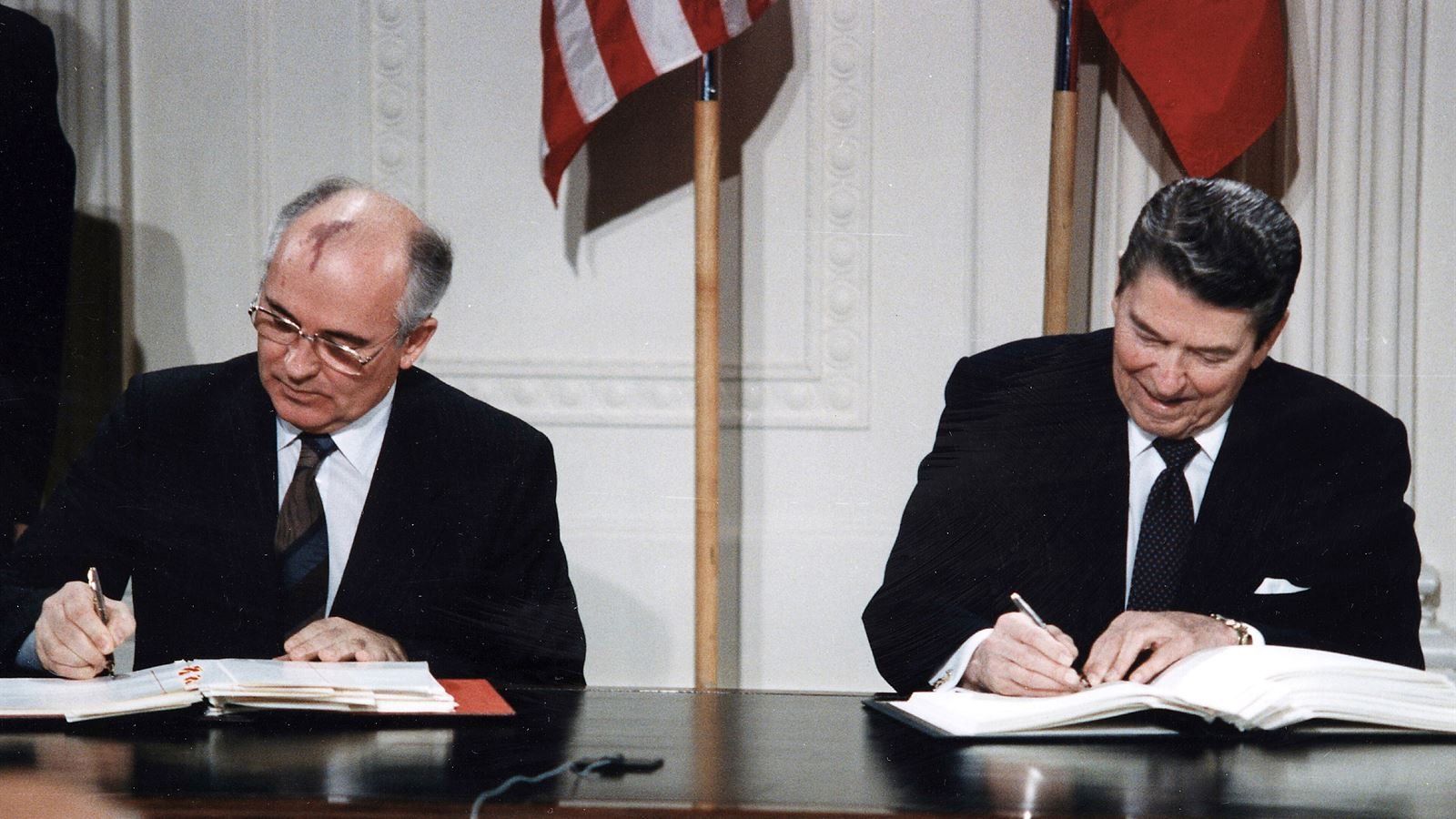
In foreign policy, the change was even greater. After a summit in Reykjavík, Iceland, in 1986, Gorbachev and US President Ronald Reagan signed the INF Treaty on December 8, 1987, eliminating both countries' intermediate-range nuclear missiles.
In February 1989, the last Soviet troops left Afghanistan. That same year, when the communist countries of Eastern Europe began toppling their governments, Moscow did not send tanks, as it had in Hungary in 1956 and Czechoslovakia in 1968. In November, the Berlin Wall fell. In 1990, Gorbachev accepted a reunified Germany inside NATO and received the Nobel Peace Prize.
The country falls apart
At home, the reforms spun out of control. The economy worsened, shops ran short of goods, and political openness gave a voice to independence movements in the Soviet republics, starting with the Baltic states. In January 1991, Soviet troops attacked protesters in Vilnius, Lithuania, and 14 people were killed, an episode that still weighs on Lithuanian memory.
In August 1991, while Gorbachev was on holiday in Crimea, party hardliners attempted a coup and kept him isolated. The coup collapsed in three days, largely because of resistance led by Boris Yeltsin, president of the Russian republic. Gorbachev returned to Moscow weakened.
On December 8, the leaders of Russia, Ukraine and Belarus met in a forest in Belarus and declared that the Soviet Union had ceased to exist. Gorbachev resigned on the 25th.
Hero in the West, culprit in Russia
Outside Russia, Gorbachev is remembered as the leader who ended the Cold War without a war and freed Eastern Europe. At home, many blame him for the economic chaos of the 1990s and the loss of superpower status. In 1996, running for the Russian presidency, he won less than 1% of the vote.
After leaving power, he set up a foundation and helped fund the independent newspaper Novaya Gazeta. He criticized Yeltsin and, later, Vladimir Putin's authoritarianism. In 2014, however, he supported Russia's annexation of Crimea. Putin, for his part, has called the collapse of the Soviet Union the greatest geopolitical catastrophe of the 20th century.
Gorbachev died in Moscow on August 30, 2022, six months after Russia's invasion of Ukraine began. Putin did not attend the funeral.
Quick questions
Who was Mikhail Gorbachev?
He was the last leader of the Soviet Union, from 1985 to 1991. He pursued economic and political reforms and negotiated the end of the Cold War with the United States.
What were perestroika and glasnost?
Perestroika ("restructuring") was Gorbachev's economic reform program. Glasnost ("openness") was his policy of political opening, with less censorship and more press freedom.
When did the Soviet Union end?
In December 1991. The leaders of Russia, Ukraine and Belarus declared the end of the USSR on December 8, and Gorbachev resigned on December 25.
Why did Gorbachev win the Nobel Peace Prize?
He received it in 1990 for his role in ending the Cold War, including nuclear disarmament deals and the decision not to intervene in Eastern Europe.
Sources
- Wikipedia: Mikhail Gorbachev
- Wikipedia: Dissolution of the Soviet Union
- Wikipedia: Intermediate-Range Nuclear Forces Treaty
- Wikipedia: 1991 Soviet coup attempt
- The Nobel Prize: Mikhail Gorbachev, 1990
Found an error? See how we fact-check and correct.