Why Korea was split in two, and why the war never ended
Two American officers picked a line on a map in 1945. Eighty years later, it still separates families, and the two Koreas are technically still at war.

In August 1945, with Japan close to surrender, two American officers were given an urgent task: propose a line to divide Korea between US and Soviet troops. Using a National Geographic map, they chose the 38th parallel.
One of them, Dean Rusk, later secretary of state, admitted afterwards that if he had known Korean history, he "almost surely" would have chosen a different line. The division was meant to be temporary.
An occupied peninsula
Korea had been a unified kingdom for centuries. In 1910, it was annexed by Japan, which ruled it with a heavy hand until the end of the Second World War.
With Japan's defeat, Soviet troops came in from the north and Americans from the south. Talks to form a single government failed as the Cold War began.
In 1948, two states were born. In the south, the Republic of Korea, with Syngman Rhee as president. In the north, the communist Democratic People's Republic of Korea, led by Kim Il Sung. Each claimed to be the legitimate government of the whole peninsula.
The war
On June 25, 1950, with Stalin's backing, the North's army invaded the South and took Seoul within days. The UN approved sending an international force led by the United States.
The war swung from one extreme to the other. The allies came close to the Chinese border, and China entered the conflict, pushing them back. By 1951, the front line had stabilized near the 38th parallel.
On July 27, 1953, an armistice was signed at Panmunjom. There was no peace treaty. An estimated 2.5 to 3 million people died, most of them civilians.
The most heavily armed border in the world
The armistice created the Demilitarized Zone, a strip about 4 kilometers wide and 250 kilometers long. Despite its name, it is surrounded by mines, barbed wire and hundreds of thousands of soldiers on both sides.
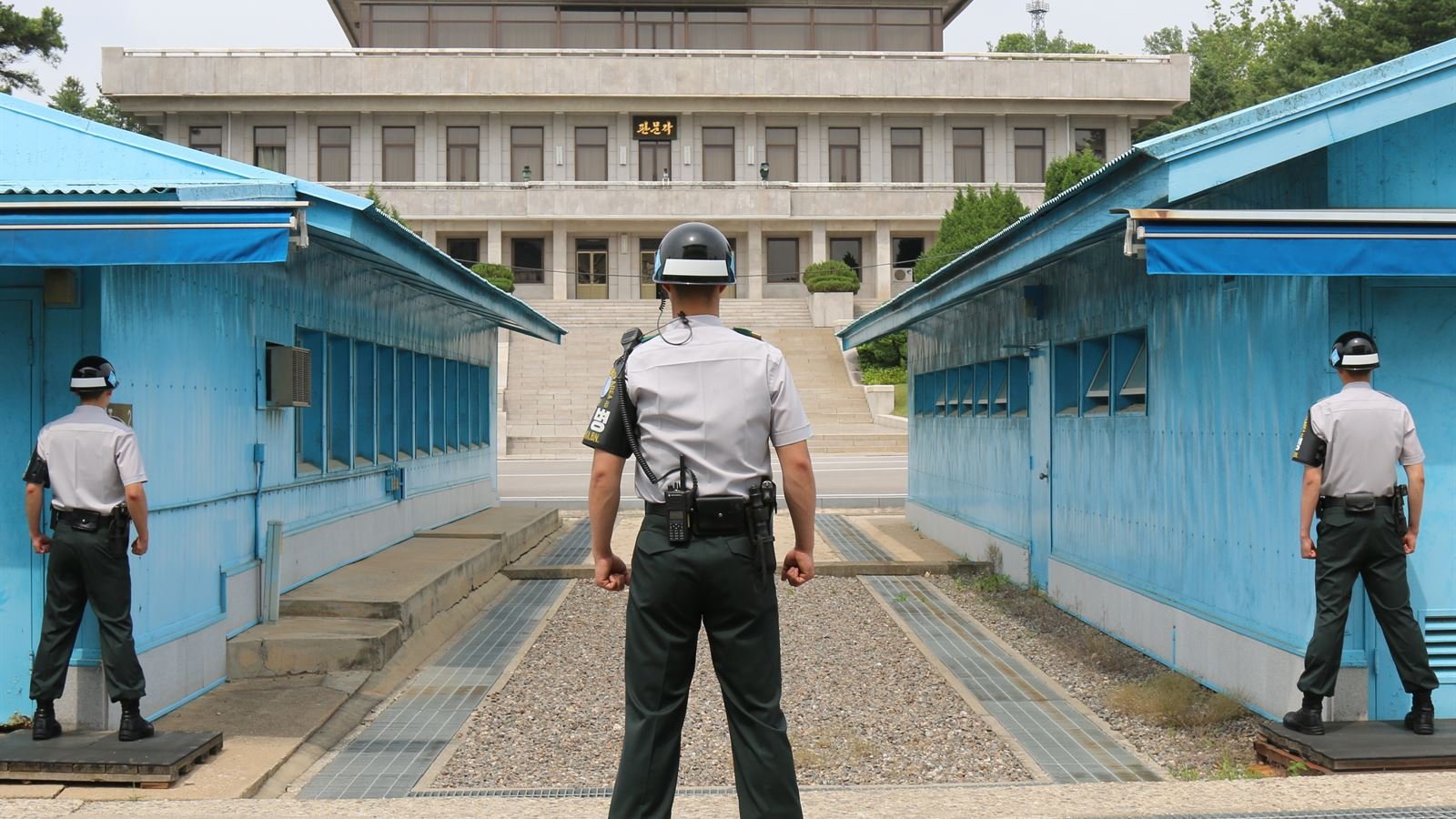
The village of Panmunjom is home to the Joint Security Area, with the blue buildings where military officers from both sides meet. Millions of families were separated by the border, and most never saw each other again.
Two opposite paths
The North became a hereditary dictatorship. Kim Il Sung was succeeded by his son, Kim Jong Il, in 1994, and by his grandson, Kim Jong Un, in 2011. In the 1990s, a famine killed hundreds of thousands of people.
The regime bet on nuclear weapons as a guarantee of survival. Its first nuclear test was in 2006, and the North has carried out six.
The South also went through military dictatorships until democratization in 1987. It then became one of Asia's richest economies, with companies such as Samsung and Hyundai and a pop culture that has conquered the world.
From hope to "hostile state"
There were moments of rapprochement. In 2018, the leaders of the two Koreas met at Panmunjom, and Kim Jong Un held summits with Donald Trump in Singapore and Vietnam. In 2019, Trump even stepped onto North Korean soil.
The talks went nowhere. At the end of 2023, Kim Jong Un abandoned the goal of reunification and began treating the South as an enemy state. In 2024, the North sent soldiers to fight alongside Russia against Ukraine.
Where things stand in 2026
South Korean President Lee Jae-myung, elected in 2025, supports dialogue and proposes replacing the armistice with a peace regime. Kim Yo Jong, Kim Jong Un's sister, called his proposals a "deceptive farce."
In November, attention is on the APEC summit in China on the 18th and 19th. According to analysts, Trump has said he wants to meet Kim Jong Un during the trip, but no meeting had been confirmed.
Why does this matter for Brazil?
The first Korean immigrants officially arrived in Brazil in 1963, escaping postwar poverty. Today, the Korean community is concentrated in São Paulo, in neighborhoods such as Bom Retiro, and helped turn the area into a fashion hub.
Quick questions
Why was Korea divided?
In 1945, the United States and the Soviet Union split the occupation of the peninsula at the 38th parallel. The division, meant to be temporary, became permanent with the Cold War.
Did the Korean War end?
The fighting stopped in 1953 with an armistice, but a peace treaty was never signed.
What is the Demilitarized Zone?
A strip about 4 kilometers wide and 250 kilometers long that separates the two Koreas.
Does North Korea have nuclear weapons?
Yes. It carried out its first test in 2006 and has conducted six nuclear tests.
Sources
- Wikipedia: Division of Korea
- Wikipedia: Korean War
- Wikipedia: Korean Demilitarized Zone
- Wikipedia: North Korea–South Korea relations
- AEI: Korean Peninsula update (Nov 11, 2026)
- Wikipedia: Korean Brazilians
Found an error? See how we fact-check and correct.